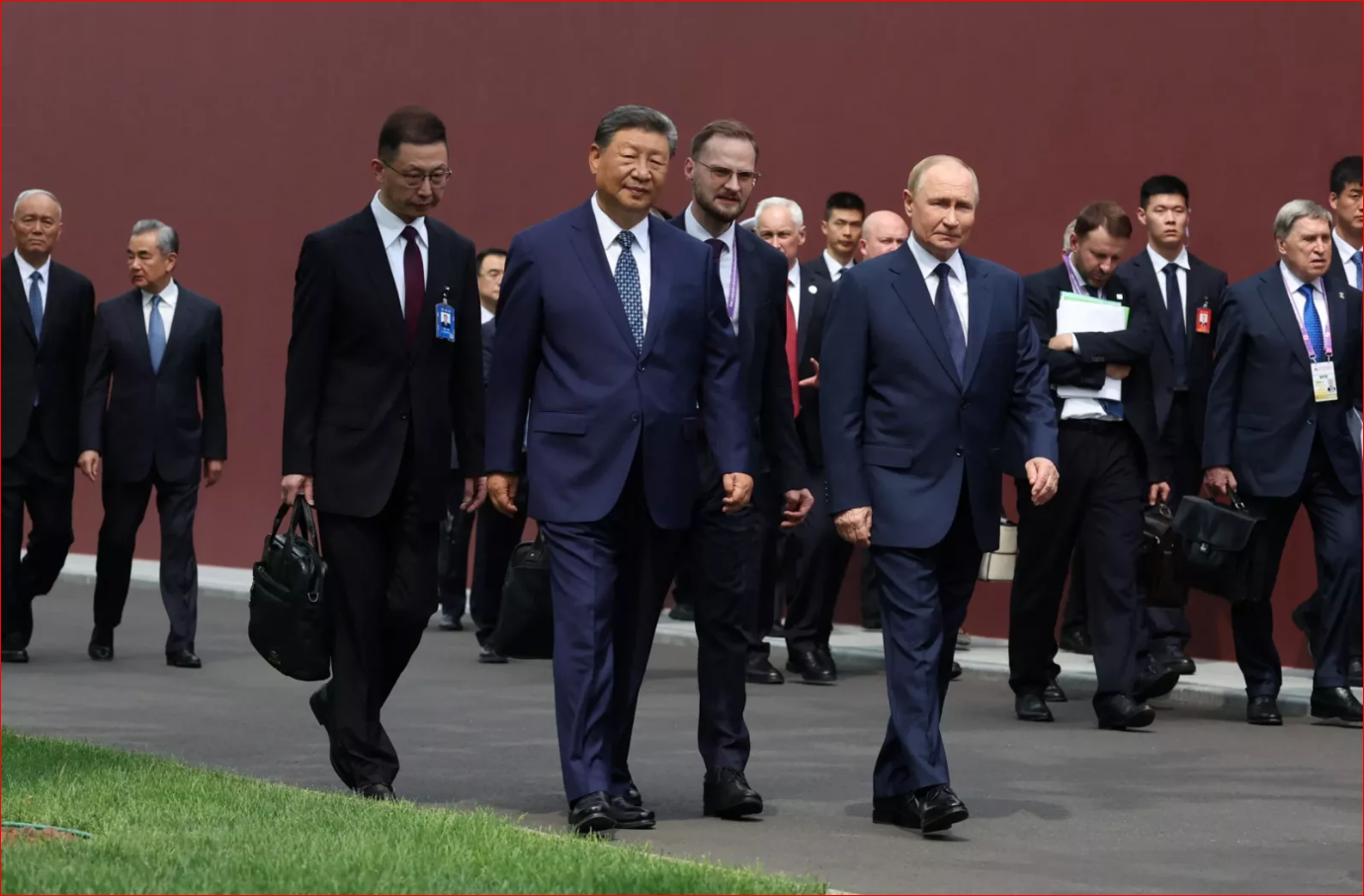
Presently, China and Russia are very close. Beijing and Moscow’s 2001 Treaty of Good-Neighbourliness and Friendly Cooperation was timely renewed in 2021. Beijing has articulated on a string of occasions that the Treaty is not of an alliance character, but plainly parrying bilateral conflicts and not aimed at any third party outside the agreement. In 2025, China and Russia issued a new statement, further propping up their no-limits strategic partnership.
In this respect, North Korea and Russia are also very close, but far more consistently throughout contemporary history as well as at present, if compared to the China–Russia case. China’s determination to have its army forwarded to the Korean Peninsula engaging in the Korean War in the 1950s, fighting side by side with North Korean military forces, was to an extent the outcome of Joseph Stalin’s influence. Stalin’s schemes and instructions were known to be the bellwether orchestrating the post-World War II communist camp where China and North Korea were among established members in the Far East.
In 2024, a bilateral Treaty on Comprehensive Strategic Partnership was signed between Pyongyang and Moscow, though the Soviet Union as a global communist superpower was long gone. But unlike the current China–Russia bond, this North Korea–Russia pact is of an ostensible military coalition nature, and may serve as an explanation for why North Korea started to send its troops to join the ongoing Russia–Ukraine war in 2024.
Unlike North Korea’s direct military involvement, China’s stance appears quite cautious this time. As a permanent member of the UN Security Council besides France, Russia, the United Kingdom and the United States, China is simply calling for an expeditious halt on the Russia-Ukraine war and a peaceful settlement on any prickly squabbles between Russia and Ukraine vis-a-vis a suspected NATO’s eastward expansion plan.
China neither condemns Russia’s pre-emptive military operations trespassing over Ukraine’s sovereignty in violation of the UN Charter, nor politically or economically asserts a stand for Ukraine’s striking back as a justifiable wrestle against alien encroachment. This is in spite of the fact that a number of Western heavyweights such as the European Union, Australia, Canada, Japan, the United Kingdom and the United States have thrown various forms of sanctions against Russia which is supposed to pay a heavy price for an unlawful foray into its adjacent neighbour.
While China now is on intimate terms with Russia, their primary shared interest is containing the United States. Harking back to the tumultuous history shared by China and Russia (and by China and the Soviet Union), the China and Russia relationship has rarely stayed non-confrontational for long. The Chinese public perception of Russia is too complicated in scope. This is because of the many different roles Russia has played in China, including as a military assailant, a revolutionary mentor, an economic and technological advisor, a political contender, or as a geopolitical stakeholder at the present moment.
China and Russia’s land border spans more than 4000 kilometres. Historically, a key feature of China–Russia relations has been their endless border disagreements tracing back to Russia’s Tsarist period. A series of border concordats have been enacted at various points in time. China and Russia signed the Complementary Agreement on the Border’s Eastern Portion in 2004. It was not until one year later in 2005, after the two countries’ supreme legislative bodies endorsed this Complementary Agreement, that the dust eventually settled after centuries of disputes and clashes over boundary matters.
Politically, China and Russia’s present closeness may count as the second honeymoon period enjoyed by the two giants. Historically, the Soviet Union was the first state in the world to recognise the legitimacy of the People’s Republic of China. The Soviets and Chinese originally shared the same ideological doctrine. The Soviet Union readily rolled out a welcome mat for the establishment of China as a new socialist companion. The ensuing development of China’s institutional frameworks and economic paradigms owed a great deal to Soviet support.
After Stalin’s death, the relationship between the two Communist parties turned sour, culminating in China and the Soviet Union becoming adversaries in a diplomatic and even military sense from the 1960s to the late 1980s. It was only after the 1989 breakthrough summit meeting between Deng Xiaoping and Mikhail Gorbachev that the normalisation of the bilateral relations was restored.
With the dissolution of the Soviet Union in 1991, Russia, as the successor state, no longer opts for having its state policy based on the Marxist-Leninist planks. But its impact on global affairs is no less stunning. On the other hand, China is still sticking to its socialist goals, trying to leverage the achievements of its 40-odd years of reform and campaign to run a more successful economy where the market dictates and the government intervenes when necessary.
In a figurative sense, the no-limits partnership forged between China and Russia sounds appealing. But from a more pragmatic perspective, it is in effect no more than a utilitarian philosophy packaged in a fresh way. Simply put, China likely has its eyes on Russia’s cheap energy and Russia’s useful influence on the world stage exerted by its current strong leadership. By the same token, Russia appears inclined to treat China as one of its indispensable sources of economic strength and a reliable partner with a more or less identical way of thinking and doing things.
But all in all, there is a catch to heed. So long as the current equilibrium between China, Russia and the United States (along with its allies around the globe) is not badly skewed, China and Russia can choose to be close as far as they are willing. Otherwise, a question mark will be cast as to the essence of their closeness in the interests of both countries. History tells and turns in cycles.
Xiaoyang Zhang is Professor at the Beijing Foreign Studies University School of Law.