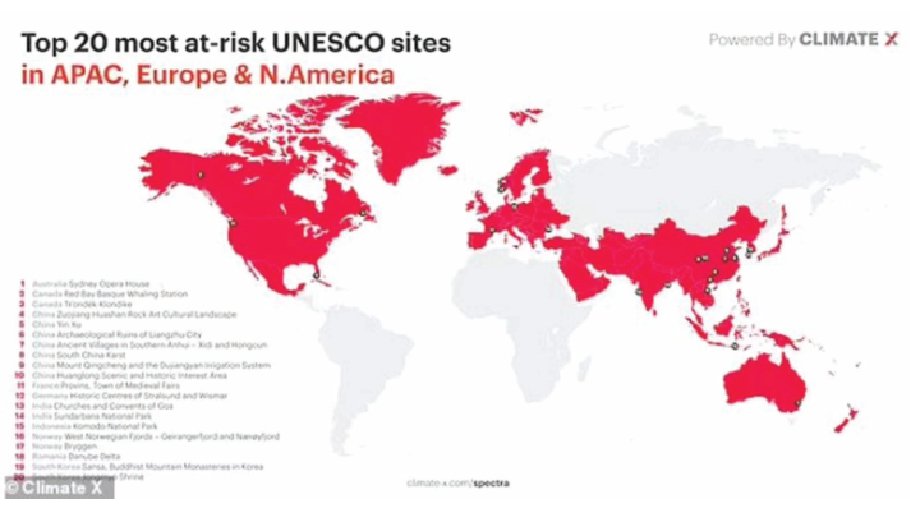
Many of the world’s most treasured landmarks face an uncertain future due to climate change. Researchers from Climate X have identified 50 UNESCO World Heritage Sites that could be lost by 2050.
Their study used advanced climate models to predict how flooding, erosion, storms, and other hazards will impact these sites. The analysis highlights significant risks to some of the globe’s most visited and cherished locations.
UNESCO's World Heritage List currently includes 1,223 sites, which are considered so important for our planet's future that they should be protected forever.
In their new study, researchers from Climate X set out to understand which of these sites could perish because of climate change.
The team used Climate X's Spectra platform, which models how climate change will affect properties, assets, and infrastructure under various scenarios.
Algorithms within the platform quantify the risk from extreme weather to model the future likelihood of 16 different climate hazards—from extreme heat to tropical cyclones and flooding—across eight warming scenarios over a 100-year time horizon.
Globally, at-risk sites include:
1. Indonesia’s Subak System is facing flooding, heat, and drought.
2. Australia’s Kakadu National Park, endangered by flooding and wildfires.
3. China’s Quanzhou: Emporium of the World, at risk from drought.
4. Australia’s Sydney Opera House, vulnerable to rising sea levels.
5. The US’s Olympic National Park, threatened by wildfires and flooding.
6. Switzerland’s Swiss Alps, Jungfrau-Aletsch, are at risk from extreme weather.
7. Korea’s Sansa Buddhist Mountain Monasteries, endangered by landslides and storms.
Lukky Ahmed, CEO of Climate X, emphasises the urgent need to protect these sites. “The potential impact of climate change is profound, not just for our heritage but also for our current assets and infrastructure,” he said.
The study used Climate X's Spectra platform to model various climate hazards over a 100-year period. It reveals that without significant reductions in greenhouse gas emissions, many of these cultural treasures could be irreparably damaged or lost.
The findings serve as a stark warning for global preservation efforts and highlight the immediate societal and economic impacts of climate change.