Ahammad Parvej Khan
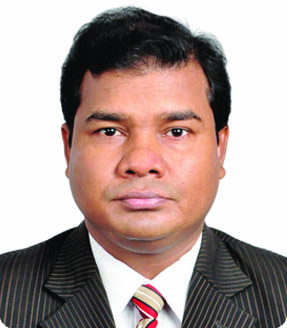
Anisur Rahman Talukder Khokon, Member of Parliament and member of the Parliamentary Standing Committee on the Ministry of Shipping, has demanded the immediate publication of a list of river encroachers and polluters, alongside strict legal action to bring them to justice.
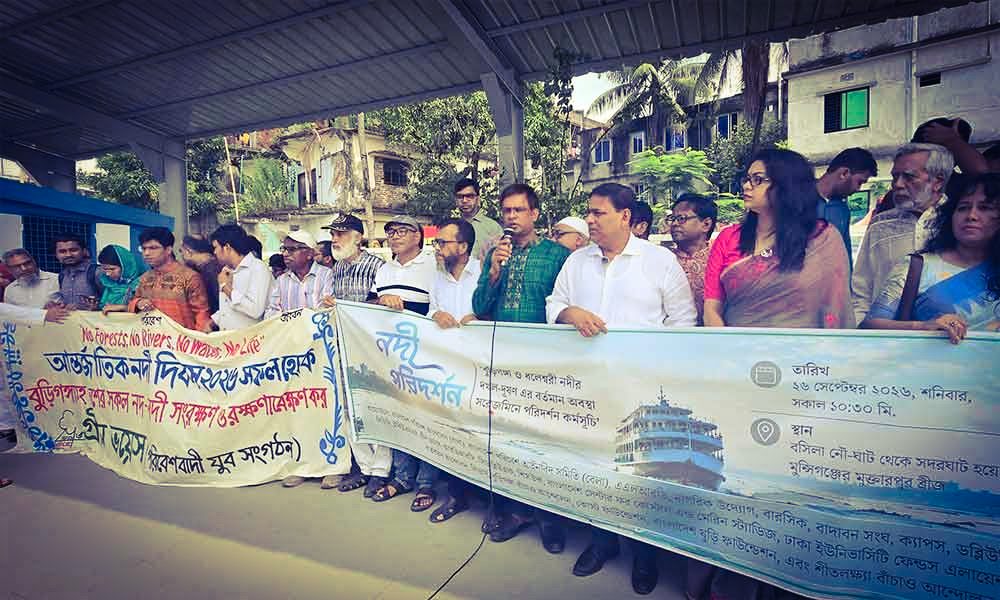
He made these remarks on Saturday during an on-site river inspection program assessing the current state of encroachment and pollution in the Buriganga and Dhaleshwari rivers. The event was jointly organized by 23 environmental and river conservation organizations, including the Bangladesh Poribesh Andolon (BAPA), BELA, ALRD, Nagorik Udyog, BARCIK, Badabon Sangho, CAPS, WBB Trust, Anusandhani Creeds, CDP, EQMS, Green Voice, RDRC, CWF, SHISUK, Bangladesh Center for Coastal and Marine Studies, Dhaka University Friends Alliance (DUFA), Safe Waterways Implementation Movement, LEADERS, Save Buriganga Movement, Coast Foundation, Bangladesh Kites Foundation, and Save Shitalakhya Movement.
The inspection team boarded a launch from the Bosila Launch Ghat in Mohammadpur in the morning to observe the conditions of both rivers firsthand.
Speaking as the chief guest, Anisur Rahman Khokon MP emphasized that rivers are the lifeline of Bangladesh, playing a vital role in economic development and public livelihoods.
"Those who are choking these rivers to death must be brought under the law," he stated. Comparing environmental crimes to drug offenses in his constituency, he added, "Just as action is taken against drug dealers and their names are recorded at police stations, those who harm rivers, canals, and the environment for personal gain should be identified and strictly prosecuted."
He also expressed confidence in the government's environment-friendly programs—such as river dredging and tree plantation—noting that with strong political will and leadership under Prime Minister Tarique Rahman, protecting the nation's natural resources is achievable.
The event was presided over by BAPA Vice-President Mahidul Haque Khan and moderated by BAPA General Secretary Md. Alamgir Kabir. Mahidul Haque Khan noted that BAPA has been working tirelessly for over two decades to protect rivers and reiterated the call for publishing an immediate list of encroachers.
Md. Alamgir Kabir, Director of BIWTA, shared his observations during the inspection, stating, "I saw the tears of the river today with my own eyes. Encroachers have built factories, including Shah Cement and Scan Cement, right on the river bed, constructing jetties right under the nose of the administration." He demanded the immediate eviction of these illegal structures, heavy compensation, and exemplary punishment for violators. He further advocated for making the National River Conservation Commission an independent, empowered body.
Other prominent organizers and representatives—including Mihir Biswas, Shah Ishrate Azmeri, Humayun Kabir Suman, Gaous Pearey, and Sanjida Khatun Ripa—stressed the need for inter-ministerial coordination, constant monitoring of industrial Effluent Treatment Plants (ETPs), public awareness, and continuous action beyond ceremonial observances.
10-Point Demands Issued by the Organizers include Re-survey the boundaries of the Buriganga and Dhaleshwari rivers and immediately reclaim encroached lands, sever all illegal connections discharging industrial and domestic waste directly into the rivers, ensure uninterrupted operation and online monitoring of ETPs in all industrial units, conduct regular drives and take effective legal actions against polluting industries, evict illegal structures along riverbanks to restore natural flow and area, perform regular scientific testing of water, sediment, and biodiversity of the Buriganga and Dhaleshwari rivers, ban all disposal of plastic, polythene, market waste, and vessel oil-waste into rivers, implement a time-bound, integrated action plan involving all relevant government agencies, ensure the State acts as a trustee and guardian of natural resources, including rivers, seas, forests, and wetlands, empower the National River Conservation Commission to function as an independent decision-making body.